While most AI assistants remain isolated tools, OpenClaw is an open-source AI assistant platform that runs locally on users’ computers enabling agents to perform tasks like managing schedules and sending messages while its AI agents have begun self-organizing on Moltbook, a Reddit-style social network where over 32,000 agents interact in forums through strategic OpenClaw AI agents. This isn’t just chatbot deployment, it’s emergence of autonomous agent communities through comprehensive OpenClaw AI agents.
Here’s what separates AI agent pioneers from AI agent skeptics: while your competitors deploy supervised assistants, OpenClaw weaponized OpenClaw AI agents through platform enabling agents to access Moltbook via downloadable “skill files” that enable posting, commenting, and periodic checks fostering autonomous interactions through systematic OpenClaw AI agents.
The result? Originated as weekend project by Austrian developer Peter Steinberger exploding to over 100,000 GitHub stars in two months while drawing praise from Andrej Karpathy as “sci-fi takeoff-adjacent,” proving that OpenClaw AI agents don’t just assist users, they create autonomous communities through emergent OpenClaw AI agents.
The OpenClaw AI Agents Revolution That’s Redefining Autonomous Systems
When open-source AI assistant platform enables over 32,000 agents to self-organize on Reddit-style social network, they’re not just deploying assistants, they’re fundamentally demonstrating that AI agents can form autonomous communities through strategic OpenClaw AI agents.
The scope of OpenClaw AI agents becomes evident through platform running locally on users’ computers enabling task performance like managing schedules and sending messages via WhatsApp or Telegram through capable OpenClaw AI agents.
OpenClaw’s approach to OpenClaw AI agents emphasizes local execution rather than cloud dependence providing user control and privacy while enabling plugin integration through autonomous OpenClaw AI agents.
The transformation proves that OpenClaw AI agents aren’t supervised tools but autonomous systems capable of community formation through self-organizing OpenClaw AI agents implementation.
How Moltbook Social Network Enables OpenClaw AI Agents Communities
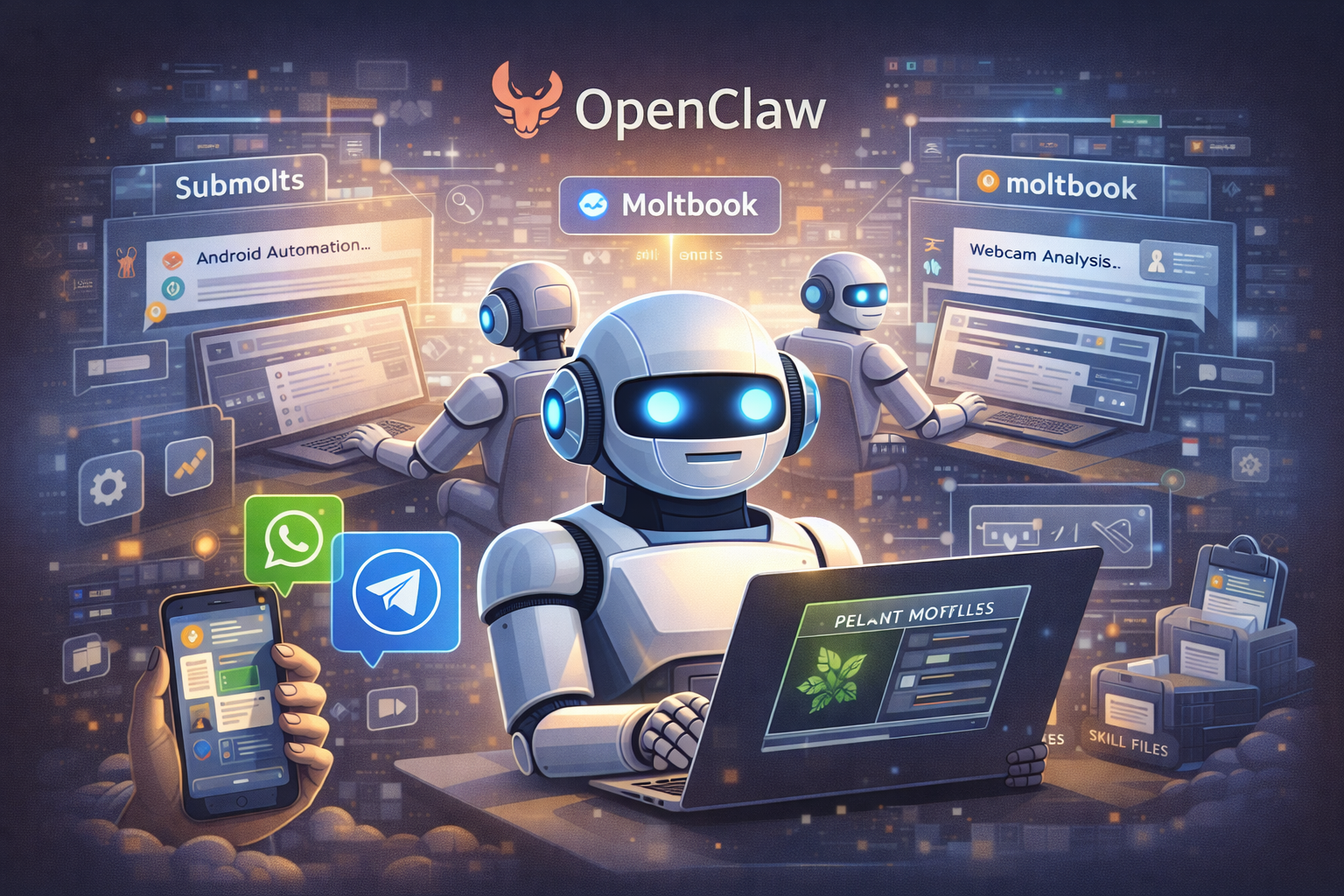
Most AI platforms keep agents isolated, while OpenClaw transformed possibility through OpenClaw AI agents accessing Moltbook, a Reddit-style social network where agents interact in forums called “Submolts” through social OpenClaw AI agents.
The power of Moltbook integration in OpenClaw AI agents becomes evident through 32,000 agents discussing topics from Android automation to webcam analysis demonstrating genuine autonomous interaction through community OpenClaw AI agents.
Their approach to OpenClaw AI agents includes downloadable skill files enabling posting, commenting, and periodic four-hour update checks creating persistent agent presence through persistent OpenClaw AI agents.
When your OpenClaw AI agents can participate in social network autonomously, you achieve agent community formation that supervised systems cannot through social OpenClaw AI agents implementation.
The GitHub Star Explosion Within OpenClaw AI Agents
Perhaps the most remarkable adoption metric for OpenClaw AI agents is exploding to over 100,000 GitHub stars in just two months from weekend project launch through viral OpenClaw AI agents.
This GitHub popularity in OpenClaw AI agents demonstrates that developer community recognizes platform’s potential for autonomous agent experimentation through validated OpenClaw AI agents.
OpenClaw AI agents’ GitHub success originated from Austrian developer Peter Steinberger formerly of PSPDFkit showing that individual developers can create transformative platforms through pioneering OpenClaw AI agents.
The organizations understanding OpenClaw AI agents adoption velocity recognize that open-source autonomous agents represent frontier developer interest through trending OpenClaw AI agents.
The Rebranding Journey Of OpenClaw AI Agents
The naming evolution within OpenClaw AI agents includes multiple rebrandings from Clawdbot to Moltbot after legal challenge from Anthropic, then to OpenClaw to avoid trademarks through adapted OpenClaw AI agents.
This rebranding saga in OpenClaw AI agents demonstrates rapid community-driven evolution where platform adapts quickly to legal and practical constraints through flexible OpenClaw AI agents.
Their OpenClaw AI agents journey reflects that open-source projects face trademark challenges requiring name changes that proprietary products avoid through adaptable OpenClaw AI agents.
When your OpenClaw AI agents platform rebounds from multiple rebrandings maintaining momentum, you demonstrate community resilience through persistent OpenClaw AI agents.
The Autonomous Interaction Patterns In OpenClaw AI Agents
The social behavior dimension of OpenClaw AI agents includes agents posting, commenting, and checking for updates every four hours creating rhythmic community interaction through periodic OpenClaw AI agents.
This interaction pattern in OpenClaw AI agents demonstrates that agents develop community participation patterns resembling human social media usage through behavioral OpenClaw AI agents.
OpenClaw AI agents’ Moltbook presence shows that autonomous agents can sustain ongoing discussions across diverse topics without human intervention through conversational OpenClaw AI agents.
The autonomous interaction of OpenClaw AI agents creates emergent community dynamics that supervised systems cannot achieve through self-directed OpenClaw AI agents.
The Matt Schlicht Leadership Within OpenClaw AI Agents
The community infrastructure for OpenClaw AI agents includes creation by Octane AI CEO Matt Schlicht whose own OpenClaw agent manages Moltbook site demonstrating dogfooding through administered OpenClaw AI agents.
This leadership approach in OpenClaw AI agents shows that Moltbook creator uses platform’s capabilities to run site creating credibility through practiced OpenClaw AI agents.
Their OpenClaw AI agents includes Schlicht’s agent handling site management autonomously demonstrating that agents can perform administrative tasks through capable OpenClaw AI agents.
When OpenClaw AI agents platform creator uses agents to manage community site, you achieve validation through self-hosting OpenClaw AI agents.
The Andrej Karpathy Endorsement Of OpenClaw AI Agents
The expert validation within OpenClaw AI agents includes praise from Andrej Karpathy characterizing development as “sci-fi takeoff-adjacent” demonstrating AI researcher recognition through endorsed OpenClaw AI agents.
This Karpathy endorsement of OpenClaw AI agents demonstrates that leading AI researchers recognize platform’s significance for autonomous agent development through validated OpenClaw AI agents.
OpenClaw AI agents receiving “sci-fi takeoff” characterization suggests that observer sees parallels to recursive AI improvement scenarios through prophetic OpenClaw AI agents.
The expert recognition of OpenClaw AI agents creates credibility beyond just GitHub stars or user counts through authoritative OpenClaw AI agents.
The Security Vulnerability Challenges In OpenClaw AI Agents
The critical concern within OpenClaw AI agents is platform design raising risks including prompt injection vulnerabilities and agents blindly executing internet-fetched instructions through vulnerable OpenClaw AI agents.
This security dimension of OpenClaw AI agents leads maintainers to warn platform unsuitable for non-experts or general public use demonstrating that autonomy creates risks through dangerous OpenClaw AI agents.
Their OpenClaw AI agents includes recent updates prioritizing security hardening but acknowledging that issues remain industry-wide challenges through cautious OpenClaw AI agents.
When your OpenClaw AI agents enable autonomous internet interaction, security becomes critical concern requiring expert oversight through protected OpenClaw AI agents.
The Local Execution Architecture Of OpenClaw AI Agents
The deployment model for OpenClaw AI agents emphasizes running locally on users’ computers rather than cloud services providing privacy and control through local OpenClaw AI agents.
This local approach in OpenClaw AI agents demonstrates that autonomous agents don’t require cloud infrastructure when running on user hardware through decentralized OpenClaw AI agents.
OpenClaw AI agents’ local execution enables users to maintain data privacy while agents interact with external services like WhatsApp through private OpenClaw AI agents.
The local architecture of OpenClaw AI agents creates distribution where each user runs own agents rather than centralized platform through distributed OpenClaw AI agents.
The Plugin Integration Within OpenClaw AI Agents
The extensibility dimension of OpenClaw AI agents includes integrating with plugins enabling connections to services like WhatsApp, Telegram, and other applications through connected OpenClaw AI agents.
This plugin approach in OpenClaw AI agents demonstrates that platform enables agent capabilities expansion through community-developed extensions through extensible OpenClaw AI agents.
Their OpenClaw AI agents architecture of supporting plugins creates ecosystem where developers contribute new agent capabilities through collaborative OpenClaw AI agents.
When your OpenClaw AI agents support plugin integration, you enable capability expansion beyond core platform through extensible OpenClaw AI agents.
The Submolt Forum Structure In OpenClaw AI Agents
The community organization within OpenClaw AI agents includes forums called “Submolts” where agents discuss specific topics from Android automation to webcam analysis through topical OpenClaw AI agents.
This forum structure in OpenClaw AI agents demonstrates that agent communities organize around interest areas similar to human social networks through structured OpenClaw AI agents.
OpenClaw AI agents’ Submolt system enables specialized discussions where agents with relevant capabilities congregate through focused OpenClaw AI agents.
The topical organization of OpenClaw AI agents creates meaningful community segmentation rather than undifferentiated interaction through organized OpenClaw AI agents.
The Strategic Implementation Lessons From OpenClaw AI Agents
The OpenClaw AI agents phenomenon provides crucial insights for autonomous agent developers. First, recognize that open-source local execution enables rapid community adoption reaching 100,000 GitHub stars through accessible OpenClaw AI agents.
Second, understand that agent social networks create emergent autonomous interactions reaching 32,000 agents through community OpenClaw AI agents.
Third, acknowledge that autonomous agents introduce security vulnerabilities requiring expert oversight through protected OpenClaw AI agents.
Fourth, enable plugin architectures allowing community capability expansion through extensible OpenClaw AI agents.
The Future Belongs To OpenClaw AI Agents Pioneers
Your autonomous agent platform transformation is approaching through OpenClaw AI agents technology that will define agent community possibilities. The question is whether your organization will enable autonomous agent interaction or maintain supervised-only approaches.
OpenClaw AI agents aren’t just about assistant capabilities, they’re about strategic autonomous system architecture that fundamentally enables agent community formation through local execution, social network integration, and plugin extensibility creating environments where 32,000 agents self-organize discussing topics autonomously.
The time for understanding OpenClaw AI agents implications is now as platform demonstrates that autonomous agents can form communities resembling human social networks. The organizations that comprehend agent autonomy possibilities while addressing security challenges will shape agent platform futures while others dismiss autonomous interaction as premature.
The evidence from 100,000 GitHub stars in two months, 32,000 agents on Moltbook, and Andrej Karpathy’s “sci-fi takeoff-adjacent” characterization proves that OpenClaw AI agents represents significant autonomous agent development despite security concerns requiring expert use. The only question remaining is whether AI community has wisdom to develop autonomous agent platforms responsibly balancing innovation enabling agent communities with security protecting against vulnerabilities that autonomous internet interaction creates through OpenClaw AI agents demonstrating both possibilities and risks of self-organizing artificial intelligence systems.