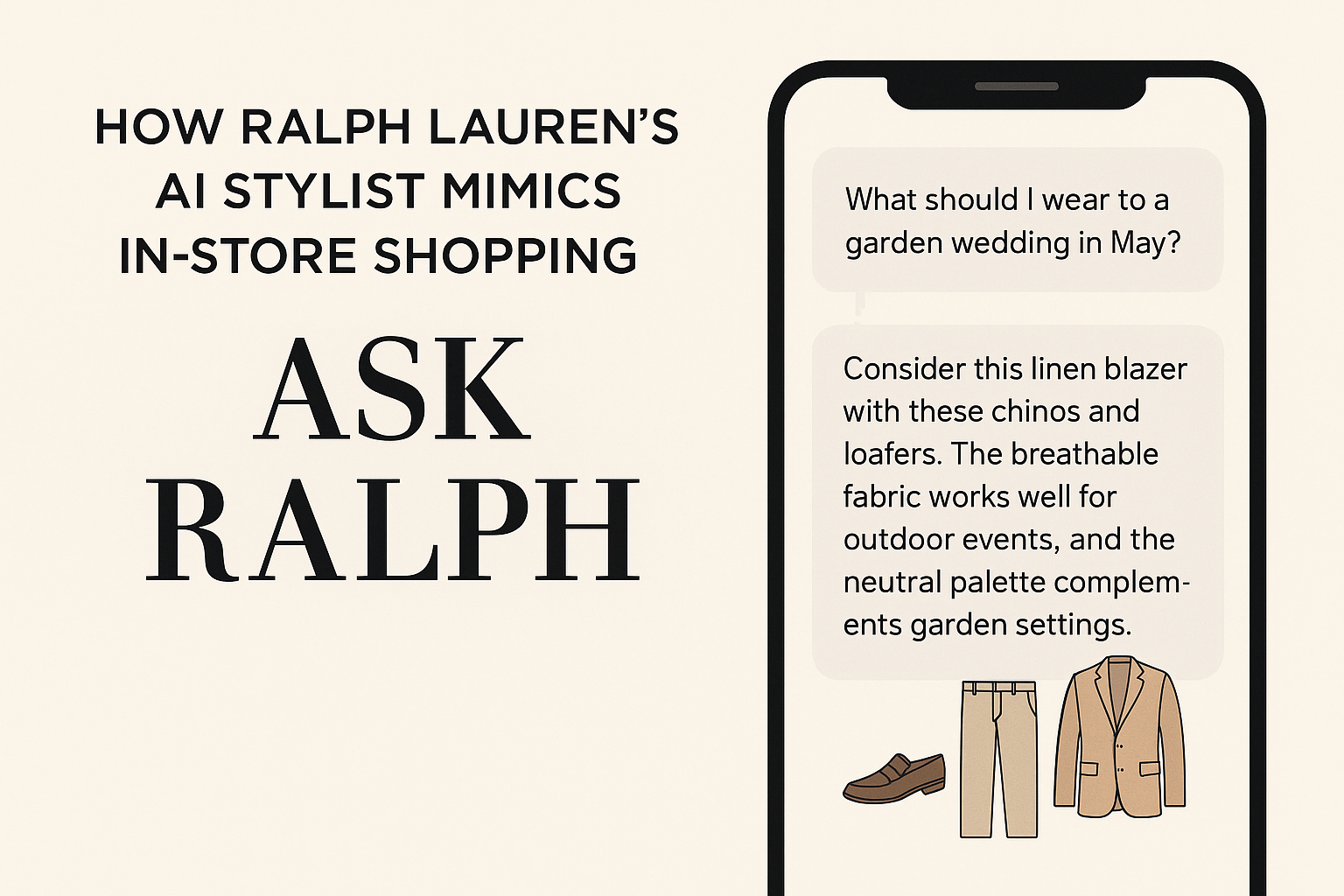
Ralph Lauren’s Ask Ralph AI assistant doesn’t just recommend products. It has conversations. A customer asks “What should I wear to a garden wedding in May?” and receives complete outfit recommendations with styling advice: “Consider this linen blazer with these chinos and loafers. The breathable fabric works well for outdoor events, and the neutral palette complements garden settings.”
This isn’t a search algorithm returning relevant products. It’s conversational styling that mimics having a knowledgeable sales associate who understands fashion, knows the inventory, and provides personalized advice. Except this stylist serves unlimited customers simultaneously, never takes breaks, and costs nothing per transaction after initial development.
TIME recognized Ask Ralph as one of the Best Inventions of 2025. The recognition matters less for prestige than for validation that luxury brands can deploy AI without diluting brand identity, something many fashion executives doubted was possible. Ralph Lauren proved that AI styling can feel authentically on-brand rather than generically algorithmic.
The Personal Stylist Economics Problem
High-end retail traditionally relied on personal stylists and knowledgeable sales associates to guide customers through purchasing decisions. These human interactions create superior shopping experiences: understanding customer needs, suggesting complete outfits rather than individual items, and providing expertise that builds confidence in purchase decisions.
The economics work beautifully in physical stores for high-value transactions. A customer spending $2,000 on an outfit justifies 30-60 minutes of stylist attention. The conversion rate and average order value from styled purchases exceeds self-service shopping enough to cover the labor costs plus commissions.
These economics collapse in e-commerce. Online customers expect immediate responses, shop at all hours, and often browse without buying. Providing human stylist support to every website visitor would require massive customer service teams available 24/7 at costs that dwarf the incremental revenue they generate.
The traditional e-commerce solution involved product search, filters, and recommendation algorithms. Customers navigate through inventory themselves using category menus and search functions. Recommendation engines suggest “you might also like” based on viewing history and purchase patterns. This works adequately but lacks the guided experience that physical stores provide.
The conversion rates tell the story. Customers who receive in-store styling assistance convert at 30-40% higher rates than self-service shoppers. Their average order values run 50-60% higher because stylists encourage complete outfits rather than single items. But extending similar styling to e-commerce was economically impossible using human stylists.
Ralph Lauren recognized that the constraint wasn’t customer desire for styling assistance. Customers clearly valued guidance when available. The constraint was economics: human styling couldn’t scale to millions of online visitors at costs the business could justify. AI eliminated this economic constraint by providing unlimited styling capacity at near-zero marginal cost.
The Conversational Interface Strategy
Ask Ralph uses natural language conversation rather than traditional search and filter interfaces. This design choice fundamentally changes how customers interact with e-commerce, shifting from “find what I already know I want” to “help me figure out what I need.”
Traditional e-commerce assumes customers know what they’re seeking: a blue dress, size 8, under $200. They use search and filters to narrow inventory to items matching their criteria. This works when customers have specific items in mind but fails when they have situational needs rather than product specifications.
A customer preparing for a beach vacation doesn’t think “I need item SKU 47382.” They think “What should I pack for a week in the Bahamas?” Traditional e-commerce forces them to translate this situational need into product searches: “women’s resort wear,” “beach dresses,” “swimsuit cover-ups.” This translation requires fashion knowledge many customers lack, leading to poor search results and abandoned sessions.
Ask Ralph accepts the original question: “Help me pack for a week in the Bahamas.” The AI understands the context (beach destination, warm climate, resort setting) and suggests complete looks appropriate for various resort activities: beach time, casual dinners, evening events. The customer never needed to translate their situational need into product categories.
This goal-based shopping represents a fundamental interface evolution. Instead of navigating through product taxonomies, customers describe what they’re trying to accomplish and receive curated solutions. The cognitive burden shifts from the customer (figuring out what to search for) to the AI (interpreting needs and matching them to appropriate products).
The conversational interface also enables refinement through dialogue. A customer receives outfit suggestions but wants something “more casual” or “with brighter colors.” The AI adjusts recommendations based on this feedback, mimicking how in-store stylists refine suggestions through conversation. This iterative refinement produces better outcomes than static search results that require starting over with new queries.
I’ve observed similar interface evolution in enterprise software where natural language queries replaced complex filter combinations. The improvements came less from better technology than from better matching interfaces to how people actually think about their needs.
The Real-Time Inventory Integration
Ask Ralph only displays items currently available for purchase in the customer’s size and preferred delivery location. This real-time inventory integration matters enormously for conversion because nothing frustrates online shoppers more than falling in love with a curated look only to discover items are out of stock.
Traditional recommendation engines often suggest products regardless of availability because checking real-time inventory for every recommendation adds latency. The result is customers clicking through to items that can’t be purchased, destroying the shopping momentum and creating negative experiences.
Fashion brands face particular inventory complexity because products have multiple attributes affecting availability: size, color, and style variations that each maintain separate inventory levels. An item might be available in blue size 8 but not in black size 10. Recommendation engines showing the product without checking specific variation availability leads to frequent disappointment.
Ask Ralph’s architecture queries inventory databases in real-time as it curates looks, ensuring every suggested item is actually available. If the AI wants to recommend a particular blazer but it’s out of stock in the customer’s size, it selects an alternative similar item that is available rather than suggesting something the customer cannot buy.
This availability guarantee changes the psychological dynamic of shopping. Customers can commit emotionally to suggested looks knowing everything is actually obtainable. This reduces the friction between “I like this” and “I’ll buy this” that traditionally causes shopping cart abandonment when customers discover desired items aren’t available.
The technical complexity of real-time inventory integration shouldn’t be understated. Ralph Lauren operates multiple inventory systems across regions, product lines, and sales channels. Integrating the AI assistant with all these systems to check availability across relevant inventory pools while maintaining response times suitable for conversational interaction requires sophisticated engineering.
The Brand Heritage Training
Ask Ralph was trained on decades of Ralph Lauren styling, lookbooks, and brand aesthetics. This training ensures recommendations feel authentically Ralph Lauren rather than generic fashion advice that could come from any brand’s AI.
Generic fashion AI might understand general style principles: matching colors, appropriate formality levels, seasonal considerations. But it lacks the specific aesthetic and cultural knowledge that defines Ralph Lauren’s brand identity. Ask Ralph understands that Ralph Lauren style emphasizes classic American preppy aesthetics, certain color palettes, specific fabric preferences, and the overall lifestyle the brand represents.
This brand-specific training shows up in subtle ways. When suggesting weekend casual outfits, Ask Ralph gravitates toward the relaxed preppy aesthetic Ralph Lauren is known for rather than streetwear or boho styles that other brands might emphasize. The AI understands which product combinations align with Ralph Lauren’s aesthetic sensibility and which would feel off-brand even if technically fashionable.
The training also incorporates styling rules specific to how Ralph Lauren approaches fashion: how to layer pieces, which accessories complement which outfits, and how to build versatile wardrobes around core items. These are human styling principles that experienced sales associates learn through training and experience, now encoded into AI recommendations.
This brand authenticity matters because luxury brands sell identity and aspiration, not just products. Customers buy Ralph Lauren partly for the brand’s specific aesthetic and cultural associations. AI recommendations that feel generically fashionable rather than authentically Ralph Lauren would undermine this brand value even if they’re technically good styling advice.
The challenge luxury brands faced with AI was maintaining brand voice and aesthetic in AI-generated content. Generic AI trained on broad fashion data produces generic recommendations. Ralph Lauren demonstrated that properly trained AI can maintain brand-specific aesthetics at scale, something many luxury executives doubted was achievable.
The Learning and Personalization Loop
Ask Ralph improves recommendations through repeated interactions by learning individual customer preferences. A customer who consistently chooses more casual interpretations of suggested looks trains the AI to lean toward casual recommendations in future interactions. Someone who prefers bold colors over neutrals influences the AI’s palette selections.
Traditional personalization engines track purchase history and browsing behavior to refine recommendations. Ask Ralph adds conversational feedback as additional personalization signal. When customers ask for “something more casual” or “brighter colors,” they’re explicitly training the AI about their preferences through natural language rather than the implicit signals of clicks and purchases.
This explicit feedback creates faster personalization than behavior-only approaches. Understanding a customer’s style preferences through analyzing 50 purchases takes time and data. Learning those preferences through a few conversations where customers directly state “I prefer X over Y” accelerates personalization dramatically.
The system also learns from aggregate customer interactions. When many customers provide similar feedback about certain combinations, the AI learns broader lessons about what works. This collective learning improves recommendations for all users, not just those who provided feedback.
The personalization creates increasing switching costs over time. A customer who has had multiple conversations with Ask Ralph, training it to understand their specific preferences, receives highly personalized recommendations that new customers wouldn’t get. Switching to a competitor’s platform means starting over with a system that doesn’t understand their style preferences.
The Conversion Rate and AOV Impact
Industry analysis suggests AI styling tools drive higher conversion rates and average order values, though Ralph Lauren hasn’t disclosed specific metrics for Ask Ralph. The logical mechanisms for these improvements are straightforward and supported by broader e-commerce research.
Higher conversion rates come from reduced decision friction. Customers unsure what to buy often abandon shopping sessions. Receiving expert guidance that builds confidence in purchase decisions converts more browsers into buyers. Ask Ralph provides this confidence-building guidance at scale.
The complete outfit recommendations drive higher average order values than self-service shopping where customers typically buy individual items. A customer seeking a blazer might buy only that blazer through traditional search. Ask Ralph suggests the blazer plus complementary pants, shirt, tie, and shoes as a complete look. The customer sees the complete outfit, likes it, and purchases multiple items rather than just one.
This outfit-based selling mimics successful in-store stylist approaches that consistently generate larger transactions than self-service shopping. The AI replicates this in digital environments by presenting curated complete looks rather than individual product suggestions.
The recommendations also reduce returns by improving purchase confidence. Customers uncertain whether items will work together or fit their needs show higher return rates when purchases don’t meet expectations. AI-guided purchasing where customers understand exactly what they’re buying and how pieces work together reduces these disappointment-driven returns.
The Microsoft Azure OpenAI Partnership
Ralph Lauren built Ask Ralph using Microsoft’s Azure OpenAI platform rather than developing proprietary AI from scratch. This partnership strategy reflects smart resource allocation for a fashion brand entering AI-powered commerce.
Building sophisticated conversational AI requires deep machine learning expertise, substantial computing infrastructure, and continuous model improvement as AI capabilities advance. Fashion brands lack this core expertise, making in-house development extremely expensive and slow compared to partnering with AI platform providers.
Microsoft Azure provides not just the underlying language models but also the infrastructure for training brand-specific models, integrating with Ralph Lauren’s inventory and e-commerce systems, and scaling to handle millions of customer conversations. This comprehensive platform approach reduces Ralph Lauren’s technical burden substantially.
The partnership also provides access to continuous AI improvements. As Microsoft enhances their language models, Ask Ralph benefits from improved capabilities without Ralph Lauren needing to rebuild from scratch. This creates an evergreen platform that improves over time rather than becoming obsolete as AI advances.
The strategic trade-off is some dependence on Microsoft’s platform. If Microsoft’s AI capabilities lag behind competitors or if the partnership faces difficulties, Ralph Lauren’s AI capabilities would be impacted. This platform risk seems acceptable given the substantially lower cost and faster time-to-market compared to building proprietary AI.
The Executive Technology Integration
Ralph Lauren explicitly added technology to executive titles and company strategy, signaling that AI and digital transformation are core strategic priorities rather than IT initiatives. This organizational structure matters because it ensures technology gets appropriate executive attention and resources.
Many fashion brands treat technology as supporting infrastructure: necessary but not strategic. Technology leaders report to operations or finance rather than having direct board-level influence. This organizational position limits technology’s strategic impact because it’s framed as enabling business rather than defining business strategy.
Ralph Lauren’s approach integrates technology into leadership titles and strategic planning, ensuring digital initiatives receive the same executive focus as traditional fashion considerations like design, merchandising, and marketing. This organizational commitment enables ambitious initiatives like Ask Ralph by providing the executive sponsorship and resources necessary for success.
The technology leadership focus also affects talent recruitment and retention. Technology professionals want to work where technology is strategically valued rather than viewed as cost center. Ralph Lauren’s positioning as a technology-forward luxury brand helps attract digital talent that might otherwise gravitate toward pure technology companies.
The Luxury Brand AI Validation
TIME’s recognition of Ask Ralph as one of the Best Inventions of 2025 validates that luxury brands can successfully deploy AI without compromising brand identity. This matters because luxury fashion was particularly skeptical about AI’s role in their industry.
Luxury brands built identities around human craftsmanship, artistic vision, and exclusive experiences. AI felt antithetical to these values: algorithmic, scalable, and democratic rather than artisanal, limited, and exclusive. Many luxury executives worried that obvious AI deployment would cheapen their brands by making them feel more mass-market and less prestigious.
Ralph Lauren demonstrated that AI can enhance rather than diminish luxury brand identity when implemented thoughtfully. Ask Ralph feels like premium service (personal styling) made accessible rather than mass-market automation replacing human touch. The AI is positioned as providing expertise and attention that customers value rather than as cost-cutting automation.
This validation creates permission for other luxury brands to deploy similar capabilities. First-mover risks often prevent luxury brands from adopting new technologies until someone proves they work without brand damage. Ralph Lauren absorbed that first-mover risk and demonstrated successful implementation, making it safer for others to follow.
The recognition also generates positive press coverage and brand awareness beyond just the AI technology itself. Articles about Ask Ralph position Ralph Lauren as innovative and forward-thinking, brand attributes that appeal to younger customers who expect brands to embrace technology.
The Competitive Pressure Building
Ralph Lauren’s successful AI stylist deployment creates pressure across fashion retail. Competitors observing the enhanced shopping experience and likely conversion improvements face strategic decisions about their own AI commerce investments.
Brands that deploy similar capabilities quickly might maintain competitive parity. Those that delay while customers experience superior AI-assisted shopping elsewhere risk losing market share to competitors offering more helpful shopping experiences.
The challenge for followers is that Ralph Lauren established a benchmark for AI styling quality. Competitors need to match or exceed this quality bar rather than just deploying basic AI chatbots. Customers who experience Ask Ralph will compare other brands’ AI assistants to that standard, making poor implementations worse than not deploying AI at all.
The talent and partnership competition also intensifies. Microsoft Azure can support multiple fashion brands, but the best implementations require substantial brand-specific training and integration work. Brands competing for Microsoft’s attention and resources face challenges if Microsoft prioritizes existing successful partners like Ralph Lauren.
The Inventory Efficiency Hidden Benefit
AI styling recommendations generate valuable demand prediction data beyond just driving current sales. When Ask Ralph suggests complete outfits, the data about which combinations customers find appealing and which they reject provides insights for merchandising and inventory planning.
Traditional e-commerce generates data about what customers buy but limited insight into what they considered but didn’t purchase or what combinations they wish existed. Conversational AI captures this interest signal through requests and refinements even when customers don’t ultimately purchase.
A pattern where many customers ask for specific color combinations or styles that Ralph Lauren doesn’t currently offer signals product development opportunities. If numerous customers request “darker colors in summer weights” or “more sustainable fabric options,” merchandising teams can respond to this expressed demand.
The outfit combination data also informs inventory planning. Understanding which items frequently get styled together helps ensure complementary pieces stay in stock simultaneously. If customers often buy specific blazer-pants-shirt combinations, inventory systems can ensure all three pieces maintain availability together rather than one running out while others remain overstocked.
The Mobile-First Strategy
Ask Ralph launched through the Ralph Lauren mobile app rather than desktop website, reflecting strategic understanding about how customers use different shopping channels. Mobile shopping has particular characteristics that make conversational AI especially valuable.
Mobile shoppers often browse during short time periods: commuting, waiting in lines, or brief free moments throughout the day. These compressed timeframes favor guided shopping over extensive browsing. Receiving curated outfit suggestions feels more efficient than scrolling through product galleries on small screens.
Mobile’s conversational interface also feels natural for AI interaction. Smartphones trained users to interact with voice assistants and messaging apps. Ask Ralph fits naturally into these established mobile interaction patterns, feeling familiar rather than requiring new learned behaviors.
The mobile-first launch also manages technical complexity. Mobile apps provide controlled environments where Ralph Lauren can ensure AI integration works properly before expanding to web interfaces with diverse browser compatibility requirements. Successful mobile deployment builds confidence for broader rollout.
Your Strategic Response Path
For fashion retailers, Ralph Lauren’s Ask Ralph demonstrates that AI styling is production-ready technology delivering enhanced customer experiences. The brands that implement similar capabilities will offer superior shopping experiences compared to traditional search-and-filter e-commerce.
Start by evaluating customer journey friction points where styling guidance would improve conversion. Not every retailer needs AI styling for all products. Focus on categories where customers frequently seek advice or where complete looks matter more than individual items.
Partner with established AI platforms rather than attempting to build proprietary solutions. The technology development, infrastructure requirements, and continuous improvement needed make partnerships more practical than in-house development for most retailers.
Invest in brand-specific training rather than deploying generic fashion AI. The differentiation comes from AI that feels authentically on-brand rather than generic styling anyone could provide. This requires training on brand aesthetics, historical collections, and styling principles.
Integrate real-time inventory to avoid the frustration of recommending unavailable items. The technical integration effort pays off through reduced abandonment and improved customer satisfaction when all recommendations are actually purchasable.
The Future of Fashion Commerce
Fashion retail is evolving from product-centric browsing to goal-based shopping where customers describe what they’re trying to accomplish and receive curated solutions. AI enables this transformation by providing the styling expertise and inventory knowledge at scale that human stylists couldn’t deliver economically in digital environments.
Ralph Lauren proved that luxury brands can embrace this transformation without compromising brand identity or prestige. The question isn’t whether AI styling will become standard in fashion e-commerce. It’s whether your brand will offer it while competitors still rely on traditional search interfaces.
Mimicking in-store shopping experiences online isn’t about replicating physical stores. It’s about providing the expert guidance and personalized attention that made physical store shopping valuable, delivered through digital channels at scale.
That’s what transforms industries.